

Camping Gear
LED vs. Gas Lanterns at the Campsite: Which One Goes Where
Put an LED lantern in the tent and a propane lantern outside. Compare brightness, run time, carbon monoxide risk and cost to see why.

Watt-hours set how long a power station runs and watts set what it can run. Here's how to size one for a camper before you buy.
You're scrolling product pages with Thanksgiving coming up, trying to choose a power station for the camper on your list. Every listing shows two big numbers, one in W and one in Wh. Here's what they mean. Watt-hours tell you how long the station runs. Watts tell you what it can run. Buy enough watt-hours to get the camper through their nights away from an outlet, and enough watts to handle the hungriest thing they plug in. The rest of the spec sheet matters much less.
Watt-hours (Wh) measure how much energy the battery holds. A 500 Wh station can run a 100 W bulb for about five hours.
Watts (W) measure flow. Output watts are how much the station can power at one moment. Input watts are how fast it recharges.
To estimate run time, use this:
Watt-hours × about 0.85 ÷ the device's watts = hours of run time
The 0.85 covers energy lost in the conversion. Estimates run from about 85% to 95%, so 0.85 is the safe end.
Worked example: a CPAP drawing 50 W on a 768 Wh station. 768 × 0.85 = about 653 usable Wh. Divide by 50 W and you get about 13 hours. That's one long night with plenty left over, or close to two shorter ones.
So start with what the camper actually plugs in. If it's phones and a string of lights, a big expensive unit is just heavy. If it's a CPAP and a fridge, a small one won't last.
These are typical ranges. Your camper's own gear may differ, and the real number is printed on the device label or its power adapter.
Notice where the jump is. Everything that charges or glows draws tens of watts. Everything that makes heat draws a thousand or more. Run the formula on a 1,500 W space heater with a 1,024 Wh station: 1,024 × 0.85 ÷ 1,500 comes to about 35 minutes. That same battery would charge phones all weekend. If someone hopes a power station will keep the tent warm on a frosty fall night, it won't. A better sleeping bag will.
The fridge math needs one caution. A compressor cycles on and off, so multiplying its running watts by 24 hours gives you a worst case. Real use is usually lower, so treat the result as a ceiling.
Prices on these units move constantly, so treat the figures below as a snapshot, not a promise.
Weekend car camper (about 300–800 Wh). This camper charges phones, runs lights, and maybe tops up a laptop or speaker for two nights. The Anker SOLIX C800 Plus is a good example of the top of this range: 768 Wh, 1,200 W output, 24 lb. Popular Science named it its camping pick at $649.99 in late 2025, so check the current price.
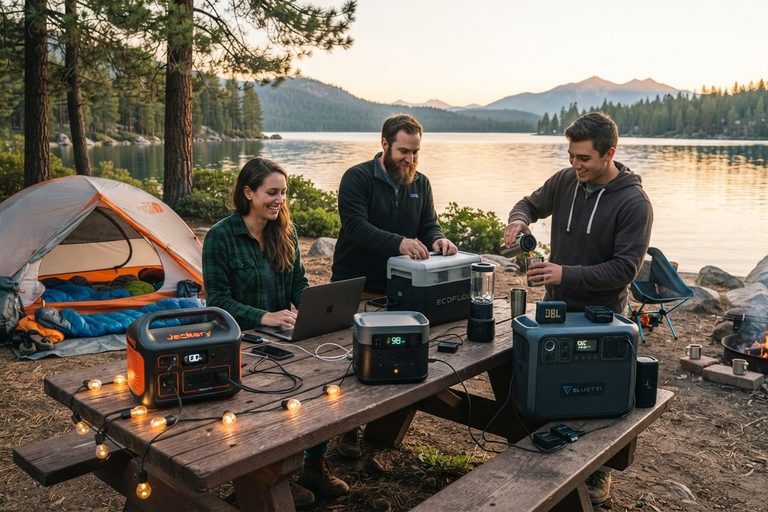
Family camper, or the one with a fridge or CPAP (about 1,000 Wh). Popular Science suggests at least 1,000 Wh for electronics. This is the size class most gift lists land in:
These four have similar capacity, so weight and price decide it. That roughly 12 lb difference between the lightest and heaviest matters if the station has to go from the car to a walk-in site.
Multi-day basecamp (about 1,500–2,000 Wh and up). This is for a long weekend or longer with a fridge running, several people charging devices, and maybe a CPAP too. Popular Science puts multi-day road trips at 1,000–1,500 Wh, and heavier use needs more. The Bluetti Elite 200v2 holds 2,073 Wh with 2,600 W output, but it weighs 53.4 lb. That's a two-hand carry from the tailgate, not something you haul down a trail. It was listed at $1,699 in October 2025.
Watt-hours decide how long the power lasts, and output watts decide whether a device runs at all. Add up the running watts of everything the camper would use at the same time, and keep that total under the station's continuous output rating. Then leave 20–30% headroom on top of that.
The headroom is for motors. A fridge compressor can briefly pull several times its running watts when it kicks on. That's why stations list a separate surge rating. The Jackery Explorer 1000 v2 is rated 1,500 W continuous and 3,000 W surge. The surge number covers a short burst at startup. It is not a second, bigger continuous rating.
If the camper might ever run a coffee maker or kettle, look for continuous output above 1,000 W. Many 1,000 Wh stations listed above clear that easily, with output between 1,500 and 2,000 W.
Solar panels. Stations recharge from a wall outlet, and select models can also charge from solar panels. Check whether a panel is actually in the box. If the listing doesn't clearly say it's included, assume it's a separate purchase. Also check the input watt rating, because that sets how fast the station refills.
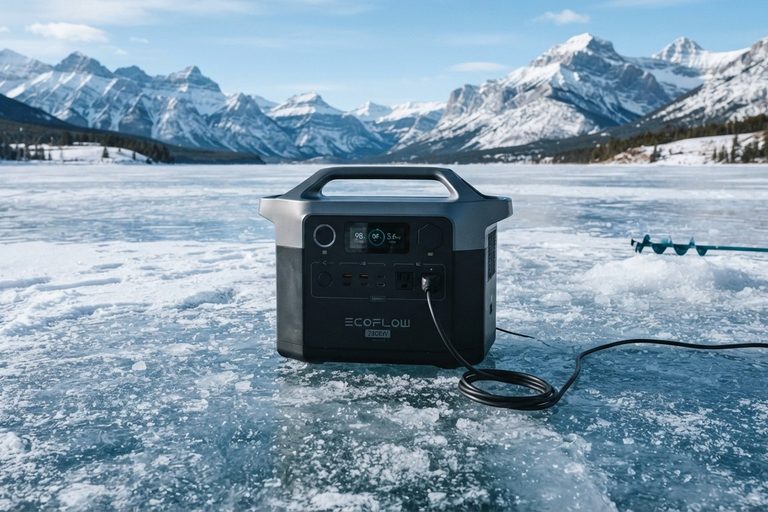
Cold weather limits charging, not running. Most LiFePO4 batteries (the chemistry used in most of these stations) charge best between 32°F and 113°F. Charging below freezing can damage the cells. Running the station usually still works down to about -4°F. For late-fall camping, that means charge the station in the warm car, not on a frozen picnic table at dawn. Some units have built-in heaters for cold charging. Popular Science's extreme-cold pick was the Bluetti Pioneer Na (900 Wh, 1,500 W, $1,299). The exact limits vary by model, and the manual has them.
Prices swing hard. The original Anker C1000 has a list price around $999 and sells for $599.99 on Anker's store. Amazon deals between late 2025 and May 2026 took it as low as $379 to $489.99. Holiday discounts in the 25–45% range are commonly reported. With Black Friday falling right after Thanksgiving on 11/27, buying before then may mean paying more than you need to.
Before wrapping it, read the manual's charging-temperature range and the store's return window. Holiday return windows sometimes run longer than usual, but check, especially if the camper might swap it for a different size.
Ask two questions, quietly if it's a surprise:
Buy for those two answers. Phones and lights for a weekend means a smaller, lighter station. A CPAP plus a fridge for four nights means 1,000 Wh or more. Anyone planning to run a heater should be gifted a warmer sleeping bag instead.
Photo by Pexels on Pixabay.
Put an LED lantern in the tent and a propane lantern outside. Compare brightness, run time, carbon monoxide risk and cost to see why.
Lithium power stations shouldn't charge below 32°F. Learn why, what Jackery, EcoFlow, Anker and Bluetti specify, and how to keep yours warm enough.
Compare the Jackery 1000 v2, EcoFlow DELTA 3 Plus and Bluetti Elite 100 V2 for a weekend trip: weight, recharge, solar, prices and real run times.