
Camping Gear
LED vs. Gas Lanterns at the Campsite: Which One Goes Where
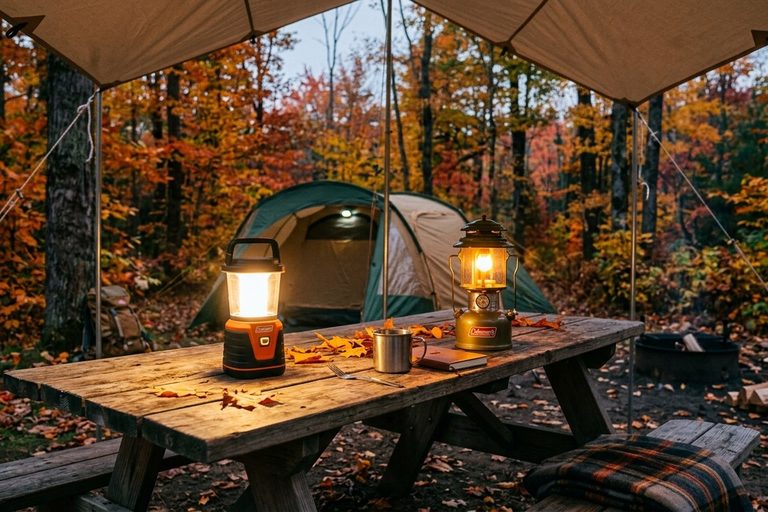
Put an LED lantern in the tent and a propane lantern outside. Compare brightness, run time, carbon monoxide risk and cost to see why.
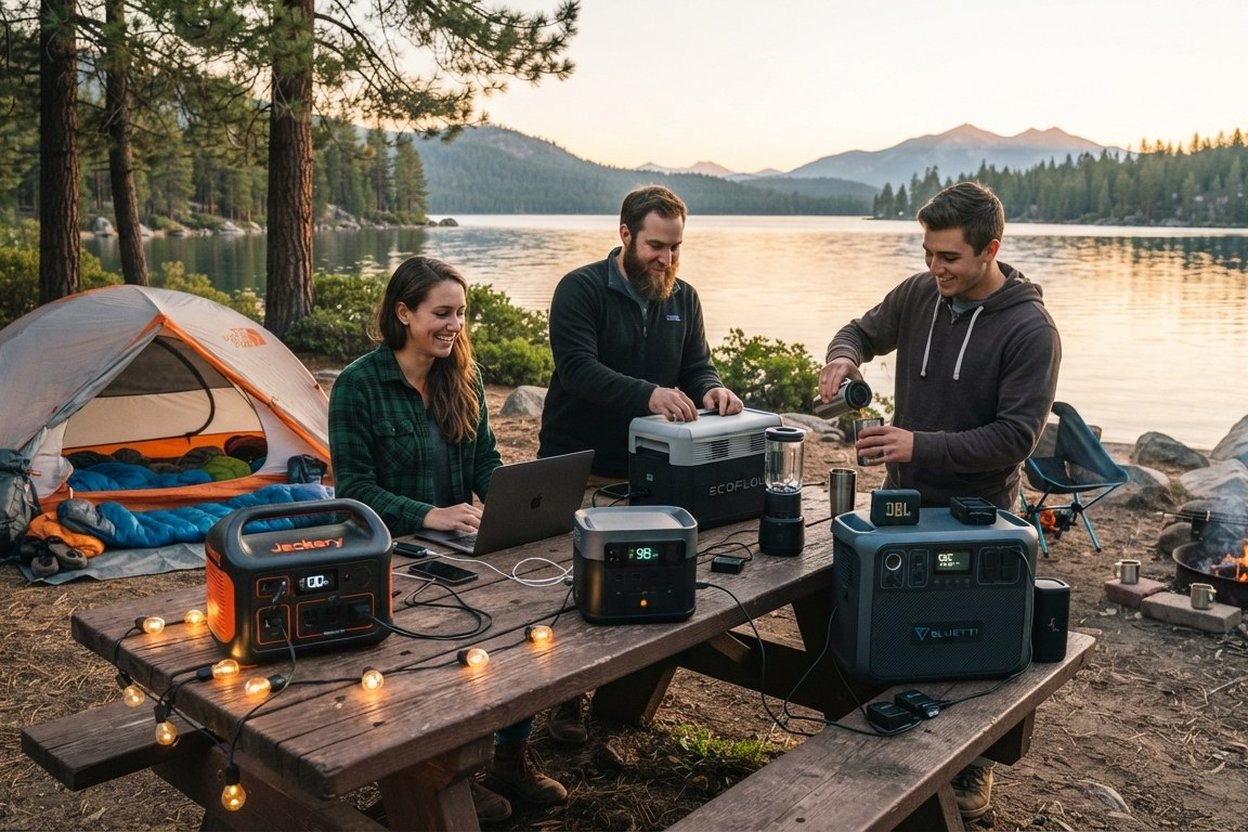
Compare the Jackery 1000 v2, EcoFlow DELTA 3 Plus and Bluetti Elite 100 V2 for a weekend trip: weight, recharge, solar, prices and real run times.
If you’re choosing a first power station for a family weekend, the EcoFlow DELTA 3 Plus is the strongest all-around pick: it recharges from a wall in 56 minutes, has six AC outlets and supports extra batteries. The Jackery Explorer 1000 v2 is easier to carry from the car, while the Bluetti Elite 100 V2 costs less and accepts more solar input.
For a typical weekend load, any of the three can work. Each is an LFP power station near 1 kWh, weighs 24 to 28 pounds and delivers about 900 Wh of usable energy at its outlets. Your best fit comes down to how you plan to carry it and recharge it.
Choose the Jackery Explorer 1000 v2 if you’ll carry your station frequently, the EcoFlow DELTA 3 Plus if you need more outlets and expansion, or the Bluetti Elite 100 V2 if you want the lowest listed price and higher solar input.
The Jackery is the lightest at 24 pounds, though its 1,500 W output is the lowest of the three. It has three AC outlets and accepts up to 400 W of solar input, making it a practical fit when the station will move between your car and campsite.
The EcoFlow weighs 27.6 pounds, has six AC outlets and supports extra batteries. Its 56-minute wall recharge is the fastest listed, which suits you if you can plug in before leaving and want to refill quickly at an electric site.
The Bluetti weighs 25 pounds and is listed at $499. It accepts up to 1,000 W of solar input, so it suits you if charging from the sun is part of your plan. For the weekend load math, budget around 900 Wh from any of them.
All three models offer about 1 kWh of LFP storage, with differences in output, weight and recharge options.
The cycle figures use different capacity thresholds. Jackery rates its 4,000 cycles to 70% of original capacity, while EcoFlow and Bluetti rate theirs to 80%. For planning your weekend, the usable-energy figures are more useful than the rated capacity: each unit delivered about 890 to 910 Wh at the outlet, so use roughly 900 Wh in your load estimate.
As of Oct. 8, 2026, the Bluetti is the least expensive listed option at $499 on Amazon, while Jackery is $559 and EcoFlow is $719.
Amazon describes the Bluetti price as cut from an $899 list price, with the offer dated Oct. 8–19. EcoFlow lists the DELTA 3 Plus at $719, marked down from $799 through Oct. 10. Jackery’s $559 price has no strike-through price shown.
These prices are snapshots from the brand sites and Amazon, and power station prices change week to week. Check the listing before you buy, especially if you’re comparing a sale price with a stated list price.
A two-night family trip can fit within about 900 usable Wh if you keep the fridge on DC, run the CPAP dry and limit AC use.
Dometic’s figure for a 12V compressor fridge in hot 90°F conditions is about 300 Wh per day, or 600 Wh across two days. ResMed’s table for the AirSense 10 estimates about 90 Wh for an eight-hour night with the humidifier off, adding about 180 Wh for two nights. With the humidifier on, consumption more than doubles.
A phone charge uses about 15 Wh, so four charges take around 60 Wh. A 10 W camp light used for four hours each night adds 80 Wh. Those loads total about 920 Wh before conversion losses, leaving little room in a 900 Wh budget. Use DC connections where you can, reduce light hours or phone charging, and skip the humidifier to keep the plan close to the station’s usable capacity. ResMed’s figures cover the AirSense 10; check your own machine’s draw, which varies with pressure, humidifier and heated tubing.
The inverter also draws about 16 W while running, so turn AC off whenever nothing needs it. Owner reviews describe fridge runtimes and CPAP nights, but actual results change with settings and conditions. For a two-night trip, the practical target is the fridge, dry CPAP, limited phone charging and short light use.
Wall power is the quickest way to refill these stations, and all three reach a full charge in roughly one to two hours.
EcoFlow is quickest at 56 minutes. Jackery lists 1.58 hours, and its one-hour emergency charging mode must be switched on in the app. Bluetti lists 70 minutes.
Solar capacity is where the models separate. Jackery accepts up to 400 W and works with Jackery panels; EcoFlow and Bluetti accept up to 1,000 W. Their 70-minute solar-charge claims assume about 1,000 W of panels in full sun, a substantial amount of equipment to haul for a weekend. A single 200 W panel takes most of a day, and real panels deliver less than their label rating.
For car charging, Jackery lists 12 hours from a 12V socket. EcoFlow’s fast 800 W car charging requires its separately sold alternator charger. If you expect to rely on the car, check the charging method and time before leaving.
Battery power stations operate quietly, while campground generator rules focus on motorized equipment, sound limits and allowed hours.
National Park Service rules cap motorized equipment, including generators, at 60 dBA at 50 feet under 36 CFR 2.12; the same regulation is available through Cornell’s legal reference. Yosemite allows generators from 7–9 a.m., noon–2 p.m. and 5–7 p.m., with quiet hours from 10 p.m. to 6 a.m. Check Yosemite’s campground rules before you go.
Sequoia and Kings Canyon allow generator use from 9 a.m. to 9 p.m., with shorter hours at Lodgepole and Dorst Creek. Quiet hours are 10 p.m. to 6 a.m.; confirm details in the park’s campground regulations. These rules address generators and engines, so check your campground’s rules for battery power stations. Yosemite campgrounds have no hookups, making a full charge before arrival useful.
Put an LED lantern in the tent and a propane lantern outside. Compare brightness, run time, carbon monoxide risk and cost to see why.
Watt-hours set how long a power station runs and watts set what it can run. Here's how to size one for a camper before you buy.
Lithium power stations shouldn't charge below 32°F. Learn why, what Jackery, EcoFlow, Anker and Bluetti specify, and how to keep yours warm enough.