
Campgrounds
How much candy do you need if kids go from site to site?
Estimate how much candy to buy for campground trick-or-treating, with a per-child formula, 2026 cost figures, and tips on allergies and bear storage.
Yes, your Halloween lights can run from the pedestal—if you use the right outlet and follow your park's rules.
You've backed into the site, the bin of orange lights and the foam tombstones is in the back, and the kids want the skeleton up before dinner. Then someone looks at the metal post with three sockets and asks whether the lights can even plug in there. Usually they can. A normal plug-in LED Halloween display runs fine from the pedestal's household-style outlet. You do need to use the right socket, keep the total load well under the breaker, and keep everything dry. Last, check the park's light rules, because a park can make you turn the display off long before the breaker would.
Most campsite pedestals with power have one outlet that looks like the socket in your kitchen. It's a 20-amp, 120-volt outlet, usually with the GFCI test and reset buttons. It's there for gear outside the RV, so plugging Halloween lights into it is what it was built for.
Seasonal and decorative lights, holiday strings included, are plug-in products designed for a nominal 120-volt input. Your light string most likely has an ordinary 15-amp household plug, and that fits a 20-amp outlet. The 20-amp receptacle (NEMA 5-20R) has a T-shaped slot that accepts a standard 15-amp plug. It doesn't work the other way: a 20-amp plug won't fit a 15-amp outlet, though that rarely comes up with decorations. A string of LED minis puts very little load on that outlet.
A full pedestal can have three outlets, and each one has a different job.
On a typical pedestal, the 20-amp and 30-amp outlets each have their own single-pole breaker, and the 50-amp outlet has a two-pole breaker (RVtravel).
The National Electrical Code requires at least one 20-amp, 125-volt receptacle on every RV site that has electrical supply. The 2023 version also says that receptacle must be weather-resistant. Under the same code, at least 70 percent of powered sites need a 30-amp receptacle. At least 20 percent of existing sites and 40 percent of new sites need a 50-amp receptacle, and every 50-amp site also gets a 30-amp (Leviton, Legal Clarity). Those are the current rules. A pedestal in an older park may have been installed before them, so look at the post itself before you trust the diagram.
To get amps, divide watts by 120. LED strings use very little power. One 100-count LED mini string sold for indoor or outdoor use is labeled 7.2 watts, 0.06 amps. A retailer comparison lists a similar LED string at about 5 watts and an incandescent mini string at 41 watts. Over a bigger display the gap adds up: about 1,000 LED minis come to around 69 watts, and the same number of incandescent minis come to around 408 watts.
Here's roughly what other common decorations draw:
How long the display stays on matters as well. The electrical code calls any load that runs three hours or more a continuous load. The practical rule is to keep a continuous load at 80 percent of the breaker's rating, which is 1,920 watts on a 20-amp circuit (ECM). Ten LED strings at 7.2 watts each total 72 watts, a tiny fraction of that. A 700-watt fogger plus a space heater or coffee maker on the same outlet is how you trip the breaker.
The tag on each light string sets a limit of its own: how many sets can be plugged end to end. That LED string's tag allows up to 29 sets (210 watts maximum), while the incandescent mini string allows only 5. Strings carry a fuse so that connecting too many sets blows the fuse before the wire overheats. With incandescent strings, you'll often reach the tag's limit before you get anywhere near the breaker's.
With LED strings, the real risk isn't how many watts they draw. It's water getting into a connection or a cord getting damaged. The Electrical Safety Foundation's outdoor decoration tips apply directly at a campsite:
On the safety-design side, the federal Consumer Product Safety Commission treats light strings without minimum wire size, strain relief or overcurrent protection as a substantial product hazard. The bargain string with no lab mark is the one to leave home.
Last, check the pedestal's cover. A 20-amp outlet in a wet location needs a cover that stays weatherproof with a plug in it, often called an "in-use" or extra-duty cover (Leviton). If the cover on your post won't close over your plug, tell the office.
No national rule bans Halloween lights at campsites. Each park sets its own rules, and they vary a lot:
Some parks go the other way and welcome the display. Cass County Conservation's 9th biennial Lighted Halloween Campground at Cold Springs Park in Lewis is a free drive-through from 7 to 9 p.m. on Saturday, October 24. Decorating starts at noon that day, and participating sites camp free that Saturday night. The office number is 712-769-2372.
Sometimes there's no household outlet to plug into. A site listed as "no hookup" has no electricity, water or sewer (Roadsurfer). Electric, water and sewer are listed separately on a reservation, and a site-type label can leave one of them out, so read the details before you book. Some older posts have only an RV socket, and a household light plug won't fit a TT-30 or a 14-50.
Adapters exist, but there's no confirmed-safe setup for running light strings from the 30-amp socket through one, so don't count on it. You can plug the lights into an outlet on the RV instead, but then they share the RV's power with everything else. A 30-amp rig has about 3,600 watts in total. That covers the air conditioner plus ordinary lights and small appliances, and it gets tight once a second high-draw appliance comes on. RV park wiring is designed around a single cord to the rig (ECM). An LED string barely affects that budget. A fog machine can.
On a site with no power at all, battery-operated lights work, and you avoid cords entirely.
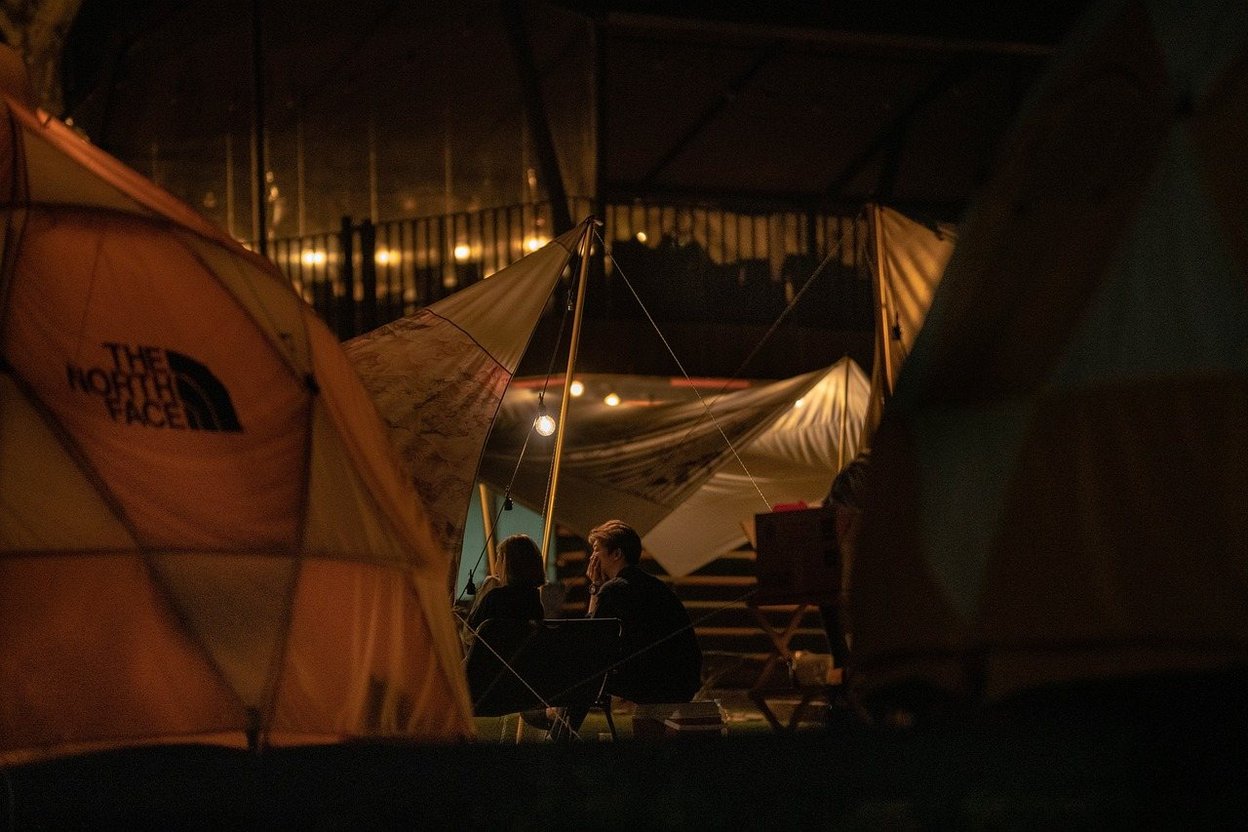
Photo by chulmin1700 on Pixabay.
Estimate how much candy to buy for campground trick-or-treating, with a per-child formula, 2026 cost figures, and tips on allergies and bear storage.
Find out whether campground Halloween costume contests allow dogs, how to confirm a pet division, and which pet rules still apply during the event.
Your campground closes before Halloween? Move your trip to an earlier event, a park open through Nov. 1, or indoor lodging.