
RVs & Campers
Where to Store Your Camper This Winter: Home, a Storage Lot or the Campground
Compare storing your camper at home, in a storage lot or at a campground this winter, with typical costs and the rules to check first.
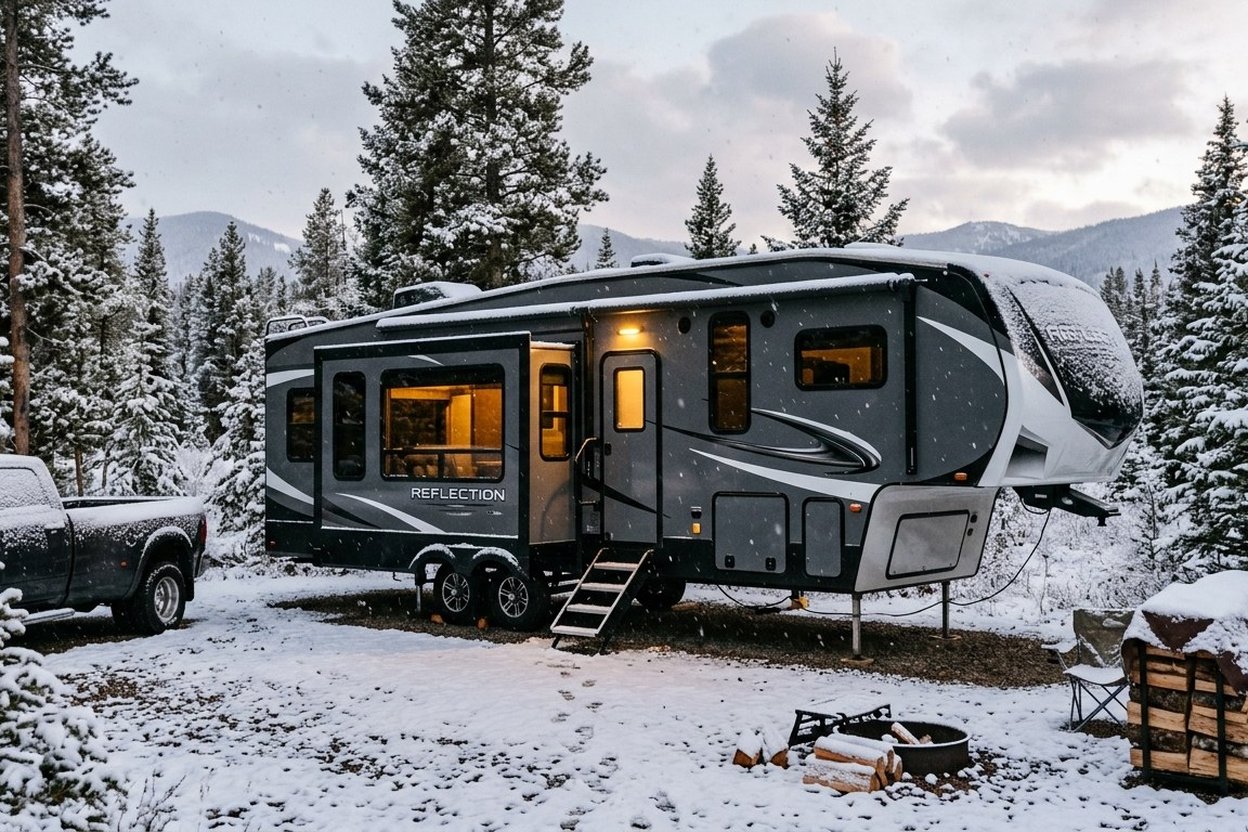
Find how much propane a camper furnace burns on a cold night, how to work out your own number from the BTU label, and how much to bring.
It's 2 a.m. in late October, the furnace has kicked on again, and you're lying there wondering whether that 20 lb tank will make it to Sunday. Most camper furnaces burn about 1 to 2.5 gallons of propane on a cold night. A mild night with the furnace cycling now and then can use about 1 gallon. A night near freezing with a big furnace running most of the time can reach 3 gallons. Here's how to work out your own number and how much to bring.
For a typical travel trailer, motorhome or camper van, figure on 1 to 2.5 gallons per night when it's properly cold. On a cool fall night when the furnace only kicks on now and then, about 1 gallon is common. When temperatures sit well below freezing and a 35,000 or 40,000 BTU furnace barely shuts off, plan for around 3 gallons.
A standard 20 lb tank holds about 4.7 usable gallons. That gives you a simple rule of thumb:
Two things decide where you land: your furnace's BTU rating and the weather outside. A small furnace on a 40°F night and a large furnace on a 10°F night are very different.
You don't have to guess. You can work out your own number with one label and some division.
Step 1: Find the BTU rating. Look for the label on the furnace itself, usually behind the access panel on the outside wall or in the owner's manual. RV furnaces typically run from about 16,000 to 40,000 BTU per hour. That rating is what the furnace burns while the flame is on.
Step 2: Divide by 91,500. One gallon of propane holds about 91,500 BTU. So a 30,000 BTU furnace running nonstop burns about 30,000 ÷ 91,500 = 0.33 gallons an hour.
Step 3: Multiply by how often it actually runs. A furnace cycles on and off, and the share of time it's actually burning is called the duty cycle. A typical duty cycle runs 30% to 60%. On a very mild night it can be much lower. One worked example has a furnace firing 4 times an hour for 2 minutes each, which is only about 13% of the time. In that case a gallon lasts about 23 hours. Owners on RV forums have estimated that with lows in the 30s and the thermostat at 68, a furnace may run 50% to 75% of the time.
Here's what that works out to over an 8-hour night:
Keep in mind that those figures cover only the 8 hours you're asleep. On a cold trip the furnace also runs in the morning and evening, so a full day can use well more than one night's worth.
The math gives you a range. Campers on RV forums show what that range looks like on actual trips. Treat these as single reports, since they come from different rigs, furnaces and setups, and not as rules.
On the milder end, one propane-planning guide estimates that a 20 lb tank lasts about 5 to 7 days on a mild fall weekend with light furnace use, and 3 to 5 days in winter with heavy use.
Why do reports differ so much? These are the factors that move your number up or down:
The fuel itself matters too. In deep cold, a tank can't turn liquid into gas as fast, so the usable output drops. Some forum owners also note that propane sold in southern states can contain more butane, which carries less energy per gallon and doesn't vaporize well below freezing.
Start with your tanks. A 20 lb tank is only filled to 80%, which leaves about 4.7 usable gallons. Many travel trailers carry two. Motorhomes usually have a larger built-in tank, and the same 80% rule applies to it: an 18-gallon tank really holds about 14.
Then plan with a margin:
To use less propane:
If you're planning a fall trip, maybe the long Thanksgiving weekend, do the math before you go. One spare 20 lb tank costs a lot less than a cold drive to the nearest propane fill in the middle of the night.
Compare storing your camper at home, in a storage lot or at a campground this winter, with typical costs and the rules to check first.
One hard freeze can crack an RV's water lines, pump and water heater. How to winterize a camper with RV antifreeze or compressed air, plus the battery, tires, seals and mice.
Dry fall weather brings burn bans and fire restrictions. What Stage 1 and Stage 2 restrictions mean for your campfire, how to check the rules, and how to put a fire out…